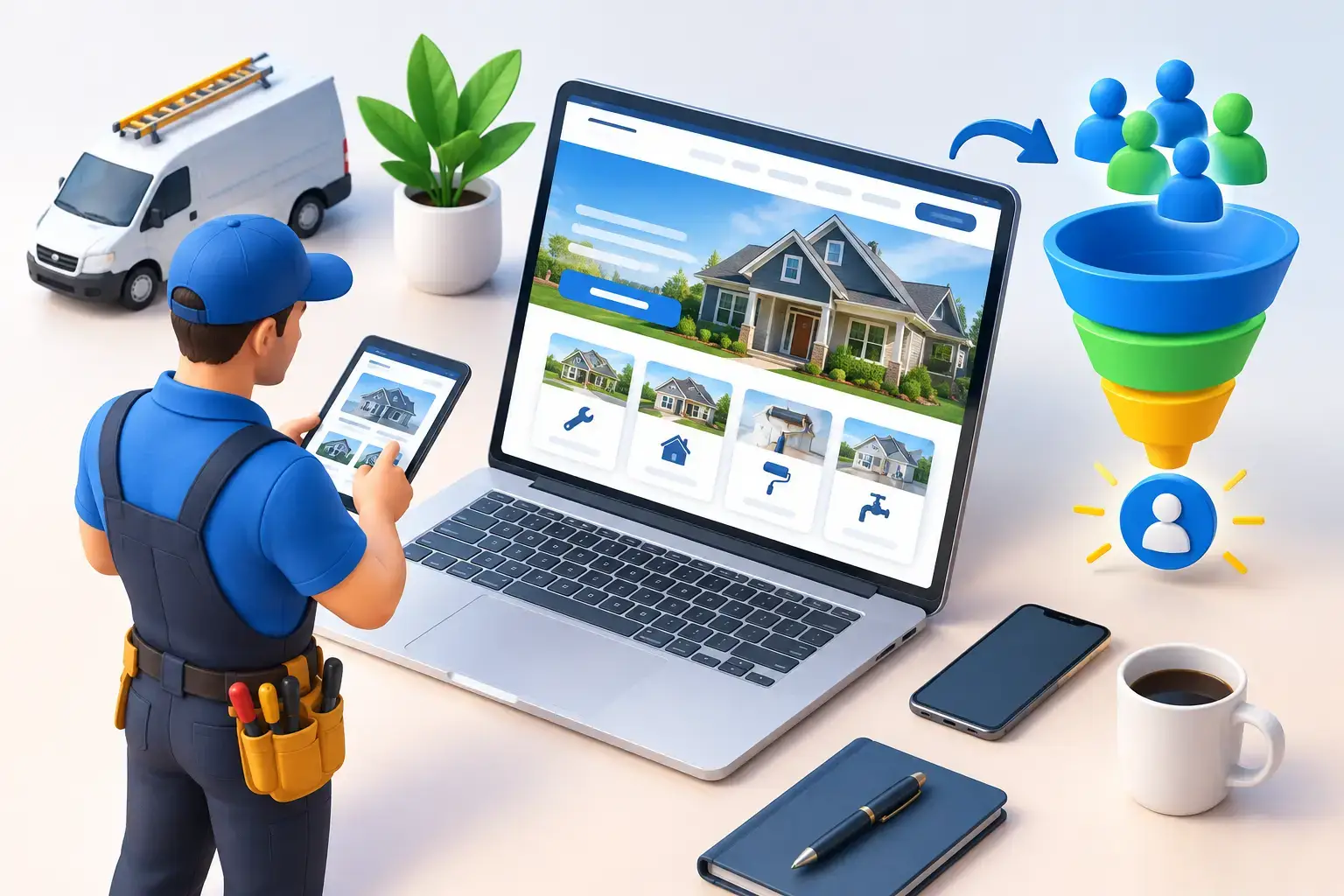
A homeowner with a leaking pipe, a buyer looking for a real estate agent, or a founder searching for a consultant is not browsing for inspiration. They want confidence, answers, and a fast next step. The best service business websites are built around that reality: they turn intent into calls, appointments, and conversations before a prospect moves on to the next option.
A polished website alone will not grow a service business. If visitors cannot quickly understand what you do, who you help, why they should trust you, and how to contact you, design becomes an expensive brochure. Your website should function more like a dependable sales representative – available at all hours, clear about your value, and ready to capture every serious inquiry.
What service business websites need to accomplish
A service website has a different job than an online store. A visitor cannot place a plumbing repair, coaching package, remodeling project, or marketing engagement into a cart and be done. They usually need reassurance before they reach out, and they may have questions that determine whether they contact you at all.
Your site therefore needs to do three things well: attract the right prospect, reduce uncertainty, and make the next action easy. That action may be booking an estimate, requesting a consultation, calling your office, or sending a message. The exact conversion depends on the service and the customer’s urgency.
For example, an emergency restoration company should make calling immediate and obvious. A business consultant selling a high-value engagement may get better results from a short application or strategy call booking. A local salon may need online scheduling. There is no universal button that works for every business, but every page should have one clear primary action.
Start with a clear value proposition
The first screen of your homepage has a few seconds to earn attention. Do not lead with vague claims such as “quality you can trust” or “solutions for every need.” Those phrases could describe almost any competitor.
Instead, state the service, the customer, and the outcome in plain language. A strong example for a landscaping company might be: “Weekly lawn care and outdoor cleanup for busy homeowners in [city].” A consultant could say: “Sales systems that help growing agencies follow up faster and close more retainers.”
Then support the message with a direct action. “Book a free estimate,” “Check appointment availability,” or “Talk to an expert” is clearer than “Learn more.” Visitors should not need to search for the next step.
Build pages around customer decisions, not your company story
Many small business websites spend too much space talking about the company and too little explaining how the customer’s problem gets solved. Your background matters, but it should support the buying decision rather than delay it.
Create a dedicated page for each meaningful service. If you offer residential cleaning, move-in cleaning, and short-term rental turnover, give each service its own focused page. This helps prospects find exactly what they need and gives search engines a clearer understanding of what your business offers.
Each service page should answer practical questions: What is included? Who is it for? What problems does it solve? What happens after someone contacts you? How quickly can you respond? If pricing varies, explain what affects the cost rather than hiding behind “contact us for pricing.” Clear expectations filter out poor-fit inquiries while making good-fit leads more comfortable reaching out.
Use proof near the decision point. Before asking someone to schedule a consultation, show a short testimonial, a project result, a rating, or a concise case example. Specific proof is more persuasive than broad praise. “Helped us fill 18 open appointment slots in one month” carries more weight than “Great service.”
Make local trust visible
For local service businesses, trust is often the real product before the service begins. A visitor may be letting someone into their home, hiring them for an expensive project, or relying on them during an urgent problem. Your website needs to reduce perceived risk.
Show your service area clearly, especially on your homepage and contact page. Include real team photos when possible, accurate business hours, a local phone number, recent reviews, and examples of completed work. If you serve several nearby cities, mention them naturally where relevant rather than cramming every location into one paragraph.
Trust also comes from useful details. A roofing company can explain what happens during an inspection. A coach can describe how the first session works. An agency can show the reporting a client receives. When people know what to expect, they are more likely to take the first step.
Remove friction from lead capture
Every extra hurdle costs leads. A prospect who has to fill out a long form, wait for a reply, or hunt for scheduling information may choose the business that responds first. Speed and simplicity are competitive advantages, particularly in crowded local markets.
Use the contact method that fits the buying moment. High-urgency services should prioritize click-to-call and quick messaging. Appointment-based businesses should let customers choose a time online. Complex or high-ticket services may need a short form that captures project scope before a sales conversation.
Keep forms short. Name, contact details, and one useful qualifying question are often enough. Asking for a full project history, budget, address, timeline, and six other details before a conversation begins can feel like work. You can gather more information after the lead is secured.
A website chat assistant can also help when your team is unavailable. The goal is not to force every visitor into a bot conversation. It is to answer common questions, direct visitors to the right page, capture contact information, and make sure an interested prospect does not leave empty-handed.
The follow-up process matters just as much as the form. A website that produces leads but sends them into an unmanaged inbox will still leak revenue. Connect inquiries to a system that alerts the right person, records the lead, and triggers a prompt response. This is where an all-in-one platform such as TwiLead can reduce the gap between marketing activity and sales follow-up.
Design for mobile visitors first
Most prospects will visit from a phone, often while distracted, rushed, or comparing options. If your site is hard to read or act on from a small screen, it is not merely inconvenient. It is turning away potential revenue.
Check the experience yourself. Can someone call with one tap? Is the booking button visible without excessive scrolling? Are service descriptions readable? Does the form work without pinching, zooming, or typing a novel? Test it on an actual phone, not only a desktop preview.
Avoid pop-ups that block the main message before a visitor has had a chance to understand your offer. A well-timed prompt can help capture leads, but an aggressive interruption can create the opposite result. The trade-off is simple: use lead capture tools to assist a decision, not to pressure an unready visitor.
Measure the actions that lead to revenue
Traffic is useful, but traffic alone does not pay the bills. A service business should track the actions that indicate buying intent: calls, form submissions, booked appointments, chat conversations, and quote requests.
Then look beyond the website conversion. Which lead sources produce qualified prospects? How quickly does your team respond? How many estimates become customers? Which services generate the highest-value jobs? These answers reveal whether you need more traffic, better pages, faster follow-up, or a stronger sales process.
Do not rebuild a website based on guesses. Improve one meaningful element at a time. Test a clearer headline, a more specific call to action, a shorter form, or stronger proof on a key service page. Small improvements at high-intent points can produce more value than a complete visual redesign.
A simple website standard for small businesses
Before investing in a new site, use a practical standard. Your website should make your offer clear in seconds, help a prospect trust you, give them an easy way to act, and make sure no inquiry gets ignored afterward. If one of those pieces is missing, more traffic will only magnify the problem.
The strongest website is not the one with the most pages, animations, or clever copy. It is the one that makes it easy for the right customer to say, “This is who I need,” and take the next step while the opportunity is still warm.