A new lead fills out a form on your website at 8:15 a.m. The notification lands in an inbox nobody checks until lunchtime. By then, the prospect has contacted three competitors. That is the real answer to why use one business platform: growth rarely stalls because a small business lacks another app. It stalls because the handoffs between apps are slow, manual, and easy to miss.
For a small business owner, disconnected software creates a hidden tax on every lead, appointment, sale, and customer conversation. You pay for the subscriptions, then pay again in lost time, duplicate work, and opportunities that slip through the cracks. One connected platform gives you a clearer path from first contact to paid customer – and a better experience after the sale.
The cost of disconnected tools is bigger than subscriptions
Most software stacks grow one urgent decision at a time. You choose a website builder, then need a form tool. You add email marketing, online booking, a CRM, texting, payment collection, and automation. Before long, your business may be using six or seven separate systems, each with its own login, billing date, contact list, and learning curve.
The monthly total matters. So does the time spent moving information between tools. A consultant may copy discovery-call details into a CRM. A home service business may manually text appointment reminders. An agency may export leads from one system and import them into another before launching a follow-up campaign. None of these tasks directly creates revenue, yet they consume attention every day.
The larger problem is that no one sees the full customer journey. Your website may know what a visitor asked for, your booking tool knows when they scheduled, and your CRM knows whether they became a client. If those systems do not communicate, you are left guessing what is working and where leads are being lost.
Why use one business platform instead of a software stack?
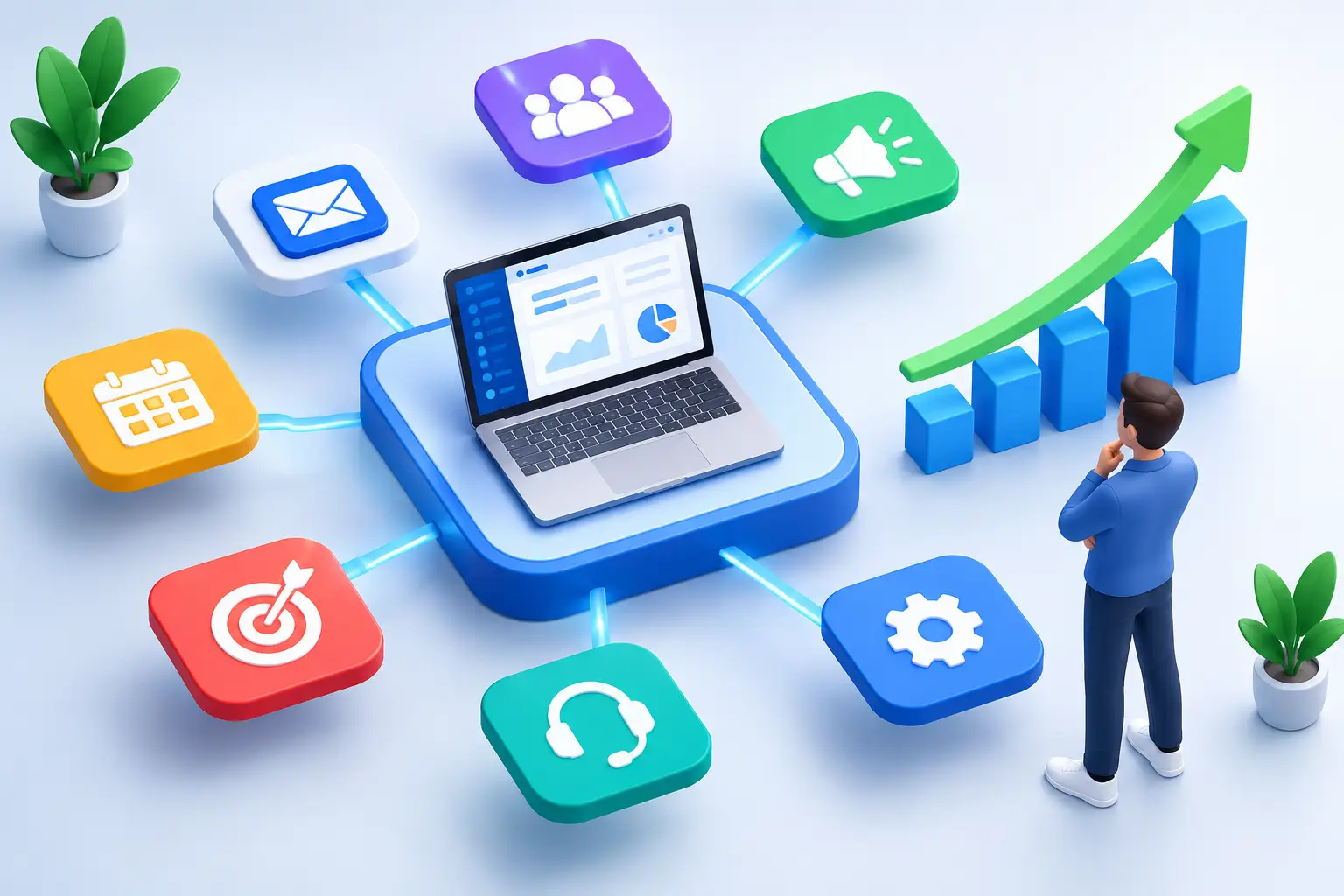
One business platform puts the tools that drive customer growth around the same record. A lead comes in, their information is captured, the right follow-up begins, and every conversation and sales stage remains visible in one place.
That changes the speed and consistency of your business. Instead of asking, “Did anyone respond to that lead?” you can see the answer. Instead of rebuilding the same contact list across multiple tools, you work from one source of truth. Instead of relying on memory to send reminders or request reviews, you create a process that runs reliably.
For a local service business, this could mean a visitor requests an estimate, receives an immediate text confirmation, books a consultation, and gets follow-up messages if they do not move forward. For a coach, it could mean a lead downloads a resource, receives helpful emails, schedules a call, and enters a sales pipeline without anyone copying data by hand.
The goal is not to use technology for its own sake. The goal is to respond faster, stay organized, and give prospects fewer reasons to choose someone else.
Faster follow-up turns interest into real opportunities
Small businesses often spend money to generate leads, then lose value through delayed follow-up. A paid ad, referral, or website visit has already created interest. The next few minutes can determine whether that interest becomes a conversation or disappears.
With disconnected systems, lead response depends on someone noticing an alert, finding the contact details, and deciding what to send. On a busy day, that sequence breaks. A unified platform can acknowledge the inquiry immediately, alert the right person, and trigger the next step based on the lead’s request.
Automation does not need to sound impersonal. It can handle the predictable first response while you prepare the personal one. A prospect who asks about a kitchen remodel can receive a confirmation, a link to schedule an estimate, and a short explanation of what happens next. Your team can then step in with context rather than starting from zero.
A better pipeline means fewer forgotten deals
The same principle applies after the first conversation. Many deals are not lost because the prospect said no. They are lost because follow-up stopped after one call, one email, or one busy week.
A shared sales pipeline shows exactly where each opportunity stands: new inquiry, contacted, appointment booked, proposal sent, decision pending, or won. More importantly, it makes the next action visible. That helps a small team prioritize revenue-generating work instead of searching across inboxes and sticky notes.
Better customer experience comes from better context
Customers do not care which tools you use. They care that you remember their request, reply promptly, show up when expected, and make it easy to pay or book again.
When customer information is scattered, conversations can feel fragmented. A customer explains their situation on a website chat, repeats it on a phone call, and receives an email that does not match what they asked for. This is frustrating for them and inefficient for you.
One platform gives your business context at the moment it matters. You can see the customer’s prior messages, appointment history, purchase status, and open opportunities without jumping between tabs. That makes it easier to deliver a professional experience, even when you are a lean team competing against larger companies.
It also supports retention. After completing a job or project, you can send a thank-you message, request feedback, remind customers about recurring services, or reconnect with past clients at the right time. These simple actions often create more revenue than constantly chasing cold leads.
Automation should remove busywork, not add complexity
Some small business owners hesitate to consolidate because they assume one platform will be difficult to set up. That concern is fair. A complicated system with features you never use is not an improvement.
The right approach is to start with the processes that create the most friction. Usually, that means lead capture, immediate follow-up, appointment reminders, sales tracking, and customer reactivation. Get those working first. Once your core journey is organized, add more automation only when it supports a clear business outcome.
Look for a platform that makes common actions practical without requiring technical expertise. You should be able to build a form, schedule a message, track a deal, collect a payment, or create a reminder without hiring a specialist for every change.
AI can help here when it has a specific job. For example, an AI website assistant can answer common visitor questions, collect contact details, and route qualified inquiries to your team. That is useful because it helps you capture leads after hours, not because it adds another trend to your business.
When multiple tools still make sense
Using one business platform does not mean every business must replace every specialized tool tomorrow. If you rely on industry-specific software for a critical service, keeping it may be the right call. A platform should simplify your growth operations, not force you to abandon tools that genuinely serve a unique need.
The question is whether each separate subscription earns its place. If a tool is used rarely, duplicates information, or requires manual work to connect with the rest of your customer journey, it may be costing more than its monthly price.
Before consolidating, map the path from a new lead to a returning customer. Note where information gets re-entered, where follow-up depends on memory, and where customers experience delays. Those are your highest-value opportunities to simplify.
What to look for in one platform
A good all-in-one solution should support the complete revenue journey: attracting leads, capturing their details, communicating quickly, booking appointments, managing opportunities, collecting payments, and staying in touch after the sale. It should also give you a clear view of what is happening without making you pay extra for every essential capability.
Pricing matters because unpredictable upgrades punish growing businesses. TwiLead, for example, combines CRM, marketing, sales, automation, websites, communication, booking, invoicing, and payments for $127 per month with unlimited users and all features included. The value is not a longer feature list. It is the ability to run more of your customer journey from one place while reducing software costs and manual work.
A simpler stack will not fix a weak offer or replace meaningful conversations with prospects. What it can do is make sure good leads receive timely attention, your sales process stays consistent, and your team spends more time serving customers than managing apps.
Start with one question: where does your business lose momentum between a prospect showing interest and becoming a customer? The right platform should help you close that gap – without adding another login to remember.