If your day starts by opening five tabs just to answer leads, book appointments, send follow-ups, and check campaign results, you do not have a software stack. You have a daily drag on growth. That is the real issue in the crm vs multiple software tools debate for small businesses. It is not just about features. It is about time, cost, visibility, and how much energy you lose managing systems that were never built to work as one.
For a small business, every extra login has a price. Every disconnected tool creates a gap between marketing, sales, service, and operations. And every gap turns into missed follow-ups, duplicate data, manual work, and slower decisions. If your team is small, or if you are the team, that friction hits hard.
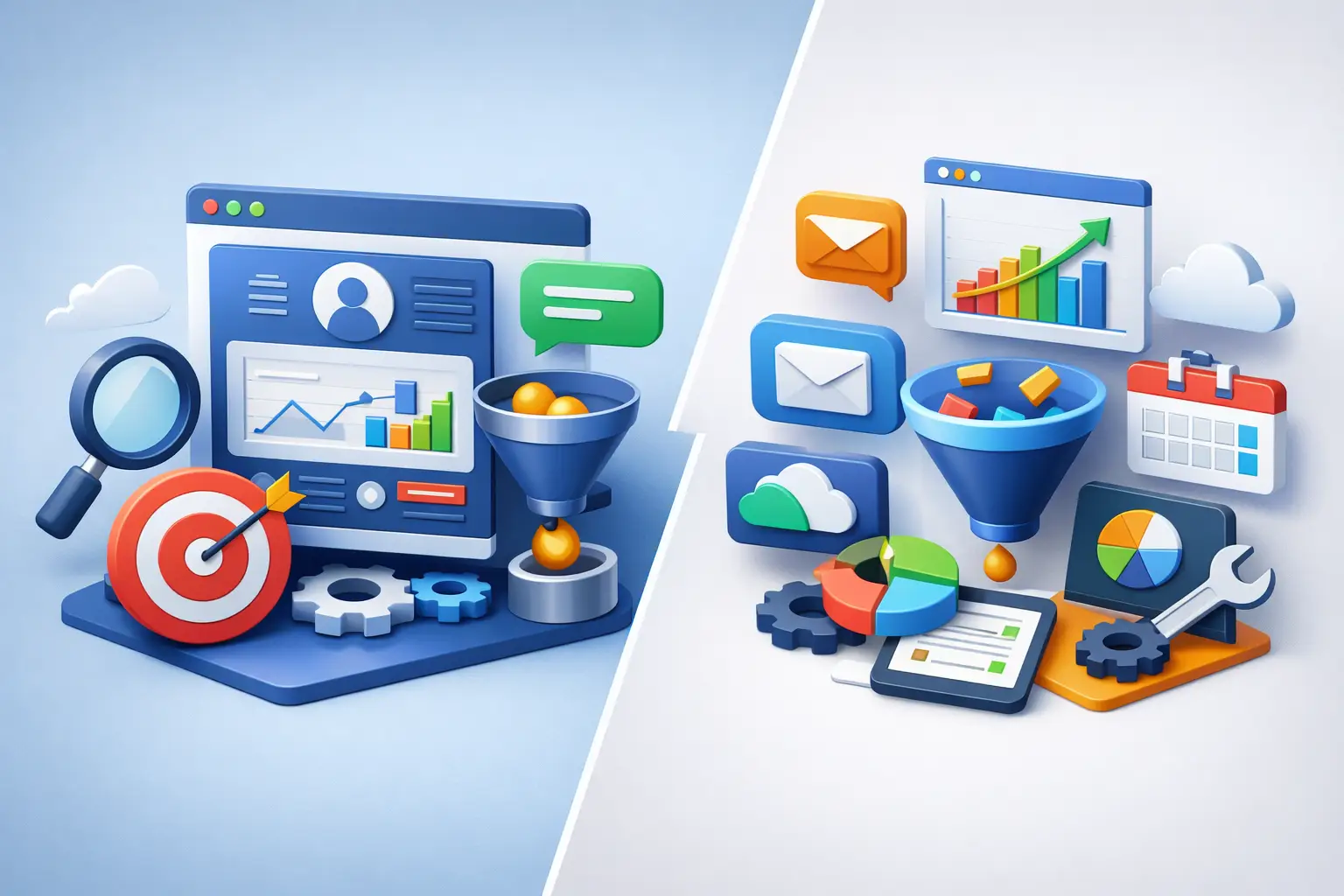
CRM vs multiple software tools: what changes in real life?
On paper, using separate tools can look flexible. You pick one app for email marketing, another for scheduling, another for pipelines, another for forms, another for invoices, and maybe a connector to glue them together. That sounds efficient until the stack grows faster than the business.
In real life, multiple tools often create four problems at once. First, your customer data gets scattered. A lead may fill out a form in one tool, book in another, receive emails from a third, and get tagged differently in each system. Second, reporting gets messy. You can see pieces of performance, but not the full customer journey. Third, costs creep up. What starts as a few affordable monthly subscriptions becomes a serious overhead line item. Fourth, your team spends time managing software instead of moving deals forward.
A CRM with broader built-in functionality changes that by centralizing activity around one record, one dashboard, and one workflow. When a lead comes in, you can track where they came from, what they clicked, when they booked, who followed up, and whether they paid – without hopping between platforms.
That does not mean a single platform is always perfect. It means simplicity usually wins when speed, consistency, and budget matter.
Why small businesses feel the pain faster
Large companies can survive some software chaos because they have specialists. One person owns automation, another owns reporting, another owns email campaigns, and someone else handles integrations. Small businesses do not have that luxury. The owner, office manager, marketer, and sales rep are often sharing the same workload.
That is why fragmented software hurts smaller teams more. It creates admin work that nobody has time to own. It also makes training harder. If every process uses a different tool, onboarding a new employee becomes a scavenger hunt. Even simple tasks like sending a quote or confirming an appointment can require three systems and a workaround.
For growth-focused teams, that is a problem. You should be spending your time getting more leads, following up faster, and keeping customers engaged. You should not be troubleshooting why the form submission did not sync to your email list.
The real cost of multiple software tools
Most business owners underestimate the cost of separate tools because they only count subscription fees. The bigger cost is operational drag.
When your software is fragmented, you pay in hidden ways. You pay for integration tools. You pay for upgraded plans when one platform limits users or automations. You pay for errors caused by bad syncing. You pay in delays when leads sit unassigned. You pay in lost revenue when a prospect slips through the cracks because two systems failed to talk to each other.
Then there is subscription fatigue. A stack that includes CRM, email, SMS, booking, website, forms, social scheduling, invoicing, contracts, and workflow automation can quickly cost hundreds each month, sometimes more than the business owner expects. And many platforms force upgrades the moment your contact list grows or you need one advanced feature.
That is why consolidation is not just a convenience move. It is often a margin move.
Where a CRM wins
The strongest case for a CRM is not that it does one thing better than every specialized tool. It is that it gives you one operating system for growth.
That matters because customer relationships are not isolated tasks. A new lead might come from a landing page, receive a text reminder, book a consultation, sign a contract, get an invoice, and enter a nurture sequence if they do not buy right away. If those steps live in separate tools, every handoff becomes a risk.
With one platform, the journey is easier to automate and easier to manage. You can build follow-up logic once instead of stitching it together with integrations. Your team can see context before replying. Your reporting becomes more usable because the data comes from the same source.
For small businesses, that often means faster response times, less manual work, and fewer mistakes. Those are not minor operational wins. They directly affect close rates and customer experience.
A platform like TwiLead is built around that exact advantage: one subscription, one system, unlimited users, and the tools small businesses actually use to generate leads, manage pipelines, automate follow-up, handle bookings, and run customer communication without piling on extra software.
Where multiple tools can still make sense
The crm vs multiple software tools question is not one-sided. There are cases where separate tools are the better fit.
If your business has highly specialized needs in one area, a niche tool may outperform an all-in-one platform on depth. A large ecommerce brand might need advanced functionality that goes beyond what most CRM platforms offer. A company with an in-house ops team may also prefer best-in-class tools because they can handle setup, maintenance, and reporting complexity.
Multiple tools can also make sense if you already have a mature stack that works well, your processes are stable, and your team is disciplined about integrations and data hygiene. In that situation, switching may not be urgent.
But that is not the reality for most small businesses. Most are not suffering from lack of advanced features. They are suffering from too much software, too little visibility, and too many manual tasks.
How to decide what is right for your business
Start with a simple question: where does work break down today?
If leads are coming in but follow-up is inconsistent, your problem is not lead generation alone. It is workflow coordination. If your team is double-entering data, your problem is not just admin. It is system fragmentation. If you dread monthly software bills, the issue is not only cost. It is stack sprawl.
From there, look at your core workflow from first touch to closed deal to repeat business. How many tools are involved? How many handoffs happen? How often does someone need to copy, paste, export, import, or manually trigger the next step?
If the answer is often, consolidation will likely help.
Also look at user limits and feature gating. Many businesses choose separate tools because the starter plan looks cheap. Six months later they are paying far more due to contact caps, user fees, automation add-ons, and extra platforms filling basic gaps. A fixed-price model with broad functionality can be easier to budget and easier to scale.
What small businesses usually need most
Most small businesses do not need a massive enterprise setup. They need a system that helps them capture leads, respond quickly, organize contacts, book appointments, send campaigns, automate routine tasks, and keep revenue moving.
That is why simplicity matters. The best system is not the one with the longest feature list. It is the one your team actually uses every day. If software feels complicated, people avoid it. If they avoid it, data gets messy. If data gets messy, automation breaks. And when automation breaks, growth slows down.
A good CRM removes that friction. It keeps the essentials in one place and makes the next action obvious. For a small business owner, that is powerful. It means less guesswork, less chasing, and more control over the pipeline.
The smarter question is not which tools are best
The smarter question is which setup helps you grow with less waste.
That reframes the decision. Instead of comparing isolated features, compare outcomes. Which option helps your team respond faster? Which one lowers total monthly cost? Which one reduces training time? Which one gives you a clearer view of what is driving sales? Which one lets you scale without adding more subscriptions every quarter?
For most freelancers, consultants, local businesses, and growing service companies, one connected platform is the cleaner answer. Not because every specialized app is bad, but because complexity is expensive when time is tight and speed matters.
You do not win by collecting software. You win by building a business that can follow up fast, stay organized, and keep customers moving through the pipeline without constant manual effort.
If your current stack feels heavier than the work itself, that is your signal. The right system should make growth easier to run, not harder to manage.