Key Takeaways
- Flywheel marketing replaces traditional linear funnels with a self-reinforcing system, focusing on customer retention and satisfaction.
- It emphasizes collaboration among marketing, sales, and customer service teams throughout the customer journey.
- The three stages of flywheel marketing are attract, engage, and delight, which encourages ongoing customer relationships.
- The rise of flywheel marketing stems from consumer distrust in outdated outbound methods, the non-linear nature of buyer journeys, and the focus on customer retention for growth.
- Implementing flywheel marketing involves aligning teams, optimizing content strategies, and leveraging technology for continuous engagement.
Introduction
What if growth didn’t depend on constantly chasing new leads? That’s the big idea behind flywheel marketing. Instead of treating marketing, sales, and customers as separate steps, the flywheel approach turns them into a self‑reinforcing system, where happy customers fuel momentum, reduce friction, and help your business grow faster over time. In this article, we’ll unpack how flywheel marketing works and why it’s a game‑changer for small businesses looking for sustainable growth.
What is Flywheel Marketing?
As you explore the web, you’ll find that there isn’t really a standard definition of flywheel marketing. Before giving you our definition of the concept, let’s quickly review a few definitions that we feel are wrong and don´t represent flywheel marketing:
- The marketing flywheel is a method of organizing the work of the marketing team internally, based on the Deming wheel: plan, develop, control, adjust. We do not share this vision.
- Flywheel marketing is simply a mindset that puts the customer at the center of the marketing and sales action. In our opinion, this mindset already exists. This is called Customer Centricity.
- Flywheel would refer to the alignment of marketing, sales and customer service teams so that they can work in synergy. This definition is not wrong, but rather it describes one of the consequences of Flywheel marketing.
At Twilead, we think of Flywheel marketing as a simplified graphic representation of the customer journey that updates the Funnel for three reasons:
- Better take into account the new elements of purchasing behavior (omnichannel, non-linear path, etc.).
- Take into consideration customer retention actions, which are simply absent from the representation of the classic marketing funnel.
- Better model actions that aim to generate revenue from existing customers, such as upselling and cross-selling.
In fact, the Flywheel takes on the strengths of the funnel while overcoming its weaknesses.
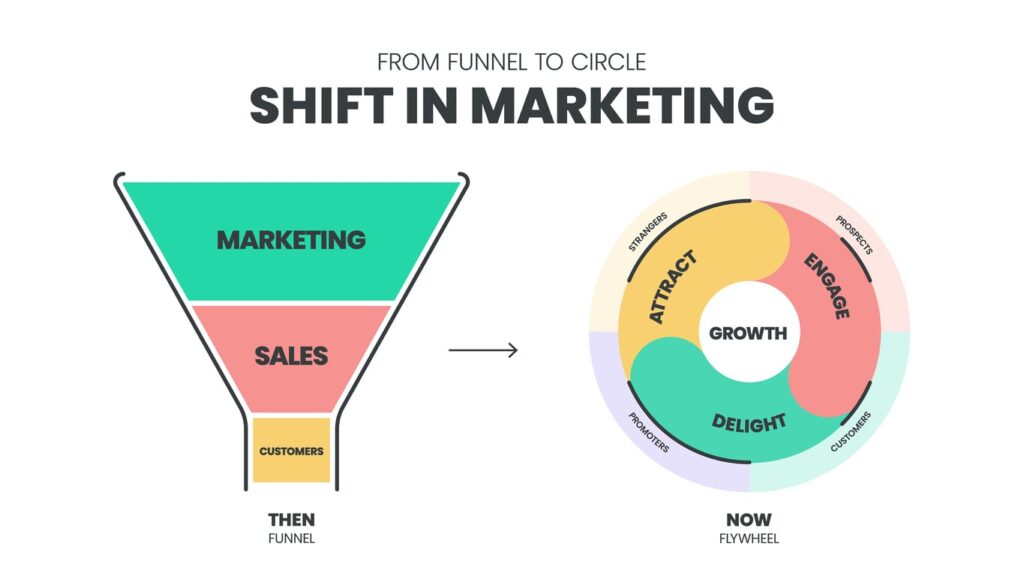
Switching from the funnel to the Flywheel involves several changes:
- We are moving from a linear, top-down journey to a cyclical one, which does not stop at the act of purchase. Thus, an effective customer becomes once again the object of a marketing and commercial effort to encourage him to buy more or to buy “better”, by going upmarket for example;
- Sales and marketing teams no longer work separately. In the funnel, marketing does its nurturing and qualification work and then passes the baton to the sales team who will be responsible for converting the qualified lead. In the Flywheel model, sales, marketing and customer service teams work closely together at all stages. We discuss this in the next section.
- The awareness, interest, decision and action stages of the funnel become attract, engage, seduce in the Flywheel. Which brings us to the next point
From funnel to flywheel marketing : Understanding the new stages of the customer journey
Flywheel marketing, therefore, reimagines the stages of the funnel without revolutionizing it. So we move to a three-stage model:
- Attract. As in the classic Inbound model, the goal here is to attract a more or less qualified audience with useful content. Here, we activate classic levers such as content marketing, search engine optimization (SEO), social media marketing, social selling, targeted paid advertising, etc.
- Engage. The aim here is to lay the foundations for a healthy relationship with the members of the audience who have shown an interest in the content disseminated in the attraction phase. Among the levers at your disposal are email marketing, marketing automation, product demonstrations, and above all, omnichannel communication with a focus on instant messaging (Live Chat).
- To seduce or enchant (delight). This is the biggest difference with the funnel. Your prospect has become a customer. He bought your product… but your job doesn’t end there. Remember that the customer’s success is also your success. You need to make sure that they are using your product to its full potential and that they are able to solve their problems with your solution.You can provide useful content (user guides, video tutorials), a Customer Success agent to accompany them, a ticket system to report technical problems, etc. The goal is to satisfy your customer to encourage him to renew his purchase, to take complementary services or products or to recommend your company to his peers.
Start building your Flywheel Marketing Strategy today
And get more leads, using TwiLead
The 3 reasons for the rise of Flywheel marketing
As you will see, the Flywheel model is not really a marketing invention. It is simply a logical and contextualized adaptation of the marketing funnel to the new buying behavior of consumers and buyers. There are three main reasons for the rise of the Flywheel.
#1 Distrust of outdated outbound marketing approaches
Think about the last product or service you purchased online. Is it the result of a cold call from an insistent salesperson? Probably not.
Is this the result of a banner ad you saw under a YouTube video? Unlikely.
Like the overwhelming majority of B2C consumers and B2B buyers, you’ve probably done a few Google searches, consumed some content to better understand your need, compared different products and prices, and read a few online reviews.
As marketing efforts and sales functions become more digital, audiences are being bombarded by cold calling and email marketing, not to mention the thousands of advertising stimuli that punctuate their daily lives, both online and in real life.
The target audience is bound to be skeptical of outbound marketing, especially if it is done the old-fashioned way, with intrusive actions.
It is therefore quite natural that Inbound Marketing has finally imposed itself in the mid-2010s, and has seen its popularity increase in the aftermath of the pandemic, which has given a big boost to the digitalization of the purchase path.
Beware: Outbound Marketing is not dead. Cold Emailing and Social Selling on LinkedIn are still essential in the prospecting effort… as long as you integrate some Inbound elements.
For example, Cold Emailing campaigns will no longer target audiences from a database without prior qualification. Instead, take a personalized approach, doing some upfront research on the interviewee, identifying their challenges and “smoothing” the approach.

To go further on this point, you can read our article on the 11 keys to a successful B2B email campaign.
In short, the confirmation ofInbound Marketing as the dominant model has pushed marketing teams to innovate, both to make marketing actions more profitable and to boost revenue generation. This is how the Flywheel model (in its contemporary version) was born.
#2 The sales funnel is not (anymore?) linear
The funnel, or funnel, is a standard and widely used way of conceiving the customer journey, from their first indirect contact with the brand (blog post, online ad, social media post, word of mouth…) to the purchase.
Based on this simplified visual representation, marketing teams work to attract the target to the funnel, and then feed them content and information to move them from the top of the funnel (TOFU for Top of the funnel) at the bottom of the funnel (BOFU for Bottom of the funnel), and then hand over to the sales team who will try to convert this qualified lead.
Again, as the buying journey has become more digital, the funnel is no longer truly linear. It has migrated from a static, standardized model to a more complex, omnichannel concept that evolves according to each buyer persona.
We talk about it in our guide Funnel Marketing: definition and (really) concrete uses.
Also, the marketing team no longer hands over to the sales team at the moment of conversion. These two teams must now work closely together.
This is called “Sales – Marketing alignment”, or “Smarketing”. Indeed, at the time of the customer meeting, the salesperson can ask marketing for content to use in the sales pitch.
On the other hand, salespeople can advise marketers in the creation of content for leads (in the lead nurturing phase), because the sales team is in direct contact with the target. They knows their concerns, interests, expectations and even their vocabulary.
#3 Retention becomes the shortest path to growth
This third point is probably the one that was most decisive in the emergence of the Flywheel marketing model.
A benchmark study conducted by Bain & Company and reported in the Harvard Business Review, explains that a 5% increase in the retention rate translates into a 25% to 95% increase in revenue. Retaining existing customers is the shortest route to growth.
In fact, since the pandemic, when prospecting efforts have become relatively complicated due to budget cuts and the fear of migrating to new suppliers to mitigate risk, more and more companies are focusing on their customer portfolio.
In concrete terms, sales and marketing teams redirect part of their efforts towards existing customers to sell them products or services that are complementary to those they have already purchased (Cross-selling), to encourage them to opt for a product or service superior to the one they already have (Upselling).
In short, the lead who has just become a customer will enter a new attraction phase, where marketing and sales will try to engage him in a new journey to buy a complementary product or service.
Keep customers buying
Unlock TwiLead. Sales and Marketing operations, all in one place.
Want to know how you could improve your business?
Our team is available for a free consultation.
Moreover, this focus on effective customers has led companies to set up a Customer Success Management (CSM) department to ensure that they derive maximum value from it, because a satisfied customer is a loyal customer.
I still use funnels: how do I switch to flywheel marketing?
You’ll be happy to know that the transition is not complicated. It is even relatively simple, since it is based on three “building sites” that you can start today:
- You need to consolidate the collaboration between your sales and marketing teams by multiplying the exchange channels. For example, you can involve sales people in your editorial meetings.
- You should also deploy a conversational marketing strategy (for example, integrating chatbots into your website), this action helps you to increase the density and speed of exchanges between visitors/leads/prospects/customers and your teams;
- Finally, you need to implement a marketing and sales strategy aimed at your existing customers to build loyalty, encourage them to buy more and eventually to recommend you. This is done through content intended for customers (tutorials, case studies on how to use your product in different situations, demonstration of new features, etc.).

Behind each entry in your customer database, there is a person with his or her history, preferences, story, and ambitions.
By focusing on existing customers, Flywheel marketing encourages us to humanize your approach by building healthy and lasting relationships with our customers. The goal is not only to increase the number of transactions.
Your goal is to grow our clients… because their success automatically equals our success.
Examples of Flywheel Marketing
Here are some real-world examples of how flywheel marketing is being applied in some companies:
Example 1: Amazon
- Attract: Amazon attracts customers with a vast selection of products and competitive pricing.
- Engage: The platform engages users with personalized recommendations based on browsing and purchase history.
- Delight: Amazon delights customers with benefits like fast shipping, easy returns, and excellent customer service, creating loyal advocates[6].
Example 2: HubSpot
- Attract: HubSpot attracts leads through valuable content such as blogs, webinars, and inbound marketing courses.
- Engage: The company engages users with personalized support and a comprehensive knowledge base.
- Delight: HubSpot delights customers with exceptional onboarding, dedicated account managers, and continuous product improvements[7].
Example 3: Shake Shack
- Attract: Shake Shack attracts customers with mouth-watering images and engaging social media content.
- Engage: The restaurant engages with its community by responding to customer feedback and creating a seamless dining experience.
- Delight: Shake Shack delights customers with high-quality food, personalized service, and exclusive deals[8].
Steps to Implement Flywheel Marketing
Implementing flywheel marketing involves several key steps:
- Define Your Ideal Customer:
- Clearly define your target audience and understand their needs, preferences, and pain points[9].
- Map the Customer Journey:
- Map out the entire customer journey from awareness to advocacy. Identify key touchpoints and opportunities to engage and delight customers[10].
- Align Teams and Processes:
- Ensure that marketing, sales, and customer service teams are aligned and working towards common goals. This collaboration is crucial for a seamless customer experience.
- Optimize Your Content Strategy:
- Create and distribute valuable content that attracts, engages, and delights your target audience. Use data and analytics to refine your content strategy continuously.
- Leverage Technology and Automation:
- Utilize marketing automation tools to streamline processes and ensure consistent engagement with customers. This includes email marketing, CRM systems, and social media management tools.
- Measure and Optimize:
- Continuously monitor the performance of your flywheel marketing efforts. Use analytics to measure key metrics and make data-driven adjustments to optimize your strategy.
Create a Flywheel Marketing Strategy with TwiLead
TwiLead is an all-in-one sales and marketing automation platform designed to enhance your flywheel marketing efforts. With TwiLead, you can:
- Automate Customer Engagement: Use TwiLead’s tools to automate customer interactions, ensuring consistent engagement at every stage of the flywheel.
- Personalize Content: Deliver personalized content at scale with TwiLead’s marketing automation features, ensuring that your messaging resonates with each customer
- Track Performance: Monitor the success of your flywheel marketing efforts with TwiLead’s comprehensive reporting and analytics tools.
- Optimize Strategies: Use TwiLead’s advanced features to optimize your marketing strategies based on data-driven insights, driving higher engagement and conversion rates.
- Collaborate Seamlessly: Ensure seamless collaboration between marketing, sales, and customer service teams with TwiLead’s unified CRM platform.
Using TwiLead’s AI-powered features, youcan streamline your flywheel marketing processes, save time, and drive more revenue.
Whether you’re looking to attract new customers, engage leads, or delight existing customers, TwiLead provides the tools and support needed to succeed in today’s competitive market.
Conclusion
Flywheel marketing is a powerful model that emphasizes continuous customer engagement and satisfaction. By following the steps outlined above and leveraging concrete examples, businesses can create a self-sustaining growth model that drives long-term success.
Start building your Flywheel Marketing Strategy today
And get more leads, using TwiLead